Archive for the 'Plant Care Questions' Category

Pink Vining Shrub Is A Mandevilla

Wednesday, July 29th, 2009

Ask the Expert: Please help me identify this flower/shrub

Mandevilla

Mandevilla

I would really love to know what sort of bush this is… if you could, I would be very grateful. Brooke

Plant Expert Reply:
What you have is a vining shrub called mandevilla. It once went by the name Dipladenia splendens but the correct name is Mandevilla x amoena. At my husband's garden center, we sell a cultivar called Alice du Pont. The plants are hardy in zones 9-11 and live year round. In zone 8 they die back in the winter and came back from the roots in the spring. In all other zones it is treated as an annual.

It loves full sun. Although a little mid-day shade is appreciated. They like plenty of moisture but it must have well-drained soil.

Dying Lucky Bamboo - Yellow and Brown Stalk

Tuesday, July 28th, 2009

Hi Jamie

Browning Lucky Bamboo

I recently came across some of your posts regarding what i believe is lucky Bamboo.  I know nothing about plants this one was left by my ex and i have noticed that it has started to turn yellow and has some funny Little brown dots on the stems it doesn't look to great, i've attached a few pictures and any advice would be very welcome.

thanks in advance.

errol

When I received this email and before I saw the pictures, I thought it can't be that bad.  I was wrong.  At this point your lucky bamboo is damaged beyond repair.  The only hope you have is to start a new plant off the section that still is green.

You will need to clean the container with hot soapy water, as well as any pebbles or rocks.  Make sure to rinse all thoroughly.  Then you will need to cut the green part of the plant away from the diseased stalks.  Once the green part is cut off, it the cut end into rooting hormone - you can get powder rooting hormone at your local garden center.  Let the powder dry on the cut and then place in your container filled with distilled water.  In a few weeks, new roots will form and you will have a new lucky bamboo plant.

Just a little side note - Most lucky bamboo that turns yellow is caused by too much fertilizer or light.  In your case the lucky bamboo didn't just turn yellow, it also developed little brown spots. This leads me to believe you that your stems had some type of fungus.  Treating lucky bamboo for fungus is a tricky thing.  It is usually better to start new ones than to try to save the diseased stalks.

Good luck and let me know if you need more instruction on how to propagate new lucky bamboo stalks.

Looks Like A Purple Crinum Lily

Monday, July 27th, 2009

Crinum Lily

Crinum Lily

Ask the Expert: id a mexican flowering plant
If found this flowering plant in Matzaclan, Mexico. It maybe from a buld.  There was no one to ask what it was, so I took a picture of it. Maybe you can id it or let me know where I can go to get identified.
thanks,
Dan

Plant Expert Reply:

It looks like a Crinum Lily - maybe a Crinum strictum or Crinum americanum.  Crinum strictum are native to Mexico and is sometimes referred to as Texas Swamplily.   It is a bulb which reproduces very slowly.  If left undisturbed will bloom with out fail for many years.


Azalea Issues Leading to Browning

Thursday, July 23rd, 2009

Ask the Expert: how to revive an azalea
my grandpa has three azalea bushes on the front of his house. they are kinda small. but one of the end ones isn't doing too great. half of it basically looks dead and the other half isn't spectacular but it looks a good bit better than the other half. the leaves and stems are turning brown as if they're drying out but they have had plenty of water due to rainfall. he has treated it with some sort of triple threat funguside called fertiloan that is supposed fight fungus and mites but it still does not look good. any suggestions on what type of treatment it might need? Tim

Plant Expert Reply:
First, you might as well prune out the brown branches that are dead. This will do 2 things: 1) removes any disease tissue that might have twig blight, 2) should stimulate the plant to produce new growth. Don't burn the branches instead place them in a garbage bag for pick up.

Second, make sure the azaleas are not getting too much water. Over-watering can present the same signs as under-watering and Azalea do not like wet feet. They are very susceptible to root rot. If your Azalea are newly planted, check the planting depth. The original top of the rootball should be slightly higher than ground level.

Planting An Azalea

Planting An Azalea

This drawing is my attempt at demonstrating the correct root-ball placement when planting an azalea. You want the root-ball positioned so that the top is slightly higher than ground level. You will take the soil you dug out of the hole and used it to close the gap but you won't need to place it on top of the root-ball. You can cover the top of the ground and root-ball top with mulch. If the Azaleas are planted too deep, they will not properly drain and the plant could have problems just like the ones you are describing.

If water isn't the issue, give the triple action time to work. It won't correct the damage already done, but it will keep it from progressing. Spider mites and fungus can also cause Azaleas to turn brown. Triple Action has the right mixture to take care of both problems.

If you haven't fertilized the azaleas, give them a dose of fertilizer specifically blended for azaleas. Your local garden center should have one. At our garden center we carry a Fertilome Azalea fertilizer and a Hi-yield Fertilizer that work well. Azaleas need a slow-release fertilizer once a month April thru August.

Good luck and keep me posted.

Transplanting A Healthly Anthurium

Thursday, July 23rd, 2009

Ask the Expert: Transplanting a healthy anthurium
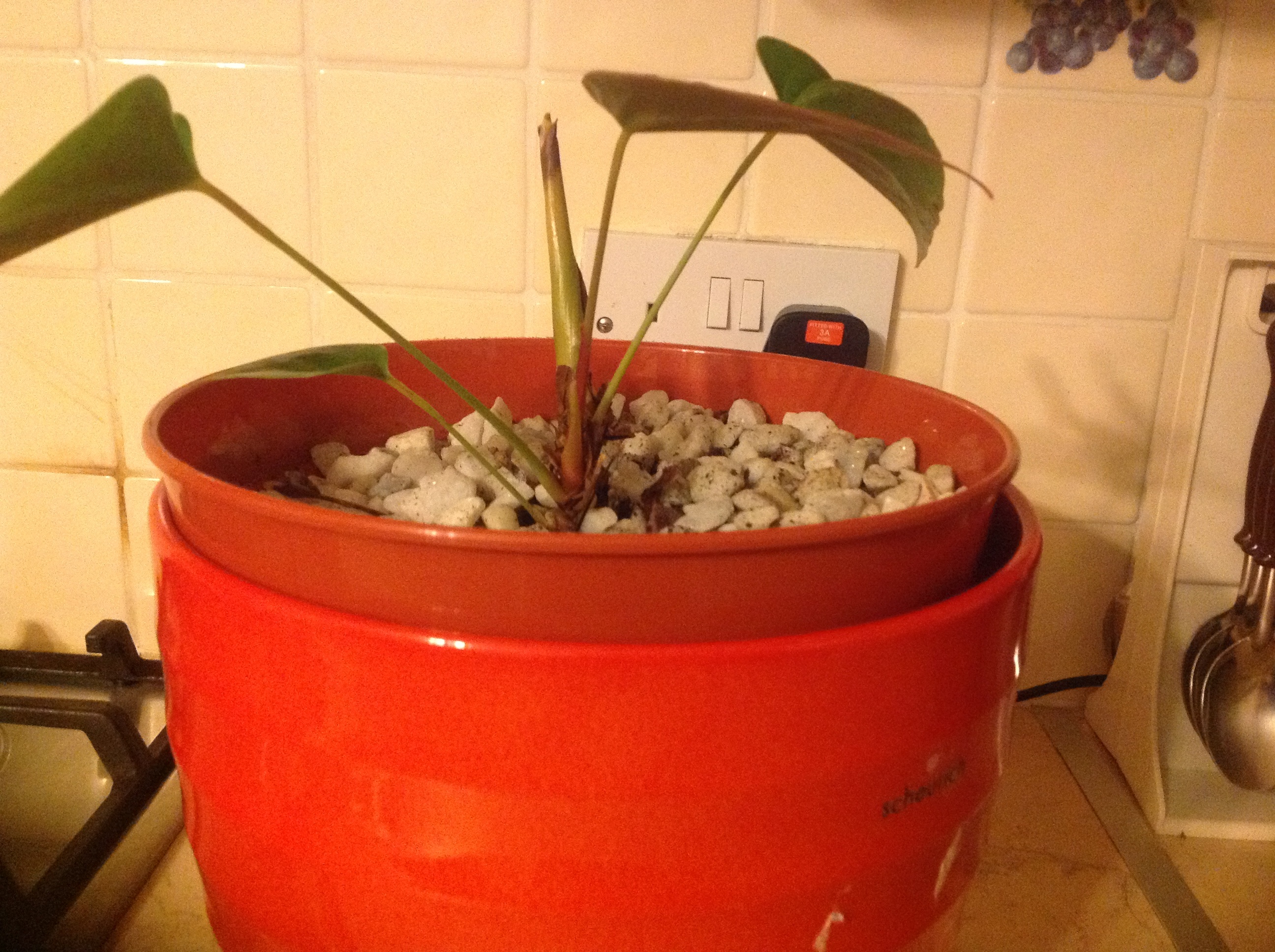
I was given what appears to be a healthy anthurium plant. It has 6 healthy leaves and is growing another. However, the literature I have read implies that the best growing medium should be more course than the medium in which it is presently growing. The medium appears to be very fine, almost a fine muck. Would it be wise to remove the medium and repot it into a more aereated medium with larger bark particles and less fine peat moss? Thank you for any assistance in this matter. NicNat

Plant Expert Reply:
I'm a live and let live kind of person. If someone or something is happy and healthy with its living conditions, I usually leave it alone. If you decide to transplant plant the Anthurium, you will want to use a humus-rich soil. So what constitutes a humus-rich soil? Soil that has a strong base of organic material (partially decayed plants and animals) and particles that allow for good drainage (course sand, perlite, vermiculite etc) makes for a suitable humus-rich soil. This soil does not have to be extremely course in texture. Your "fine muck", as long as it drains well, could be a humus-rich soil and the reason the plant is thriving.

When transplanting the Anthurium don't try to remove the existing soil from the roots. Simply shaking any loose soil from the plants and place in the new pot with humus-rich soil. Be sure to keep the plant level the same as it was in the old pot.

Good luck with your Anthurium and keep me posted.

Happy Birthday Jamie!

Wednesday, July 22nd, 2009

That's right! Today is Jamie Jamison Adams' birthday. Our plant and flower expert is another year older but doesn't look it at all! Everyone at Flower Shop Network is spending the day wishing her a happy birthday so we thought we'd give her one giant blog birthday card that says…

Happy Birthday Jamie!

Jamie's Flower Shaped Cupcake Birthday Cakes

Jamie's Flower Shaped Cupcake Birthday Cakes

Sending Flowers? Don't Forget To List Your Second Choice

Tuesday, July 21st, 2009

This is one flower sending tip that you won't want to be without. Florists run across an issue often when they are asked to create an arrangement based on something seen in a magazine, on a floral website, or a wire service design gallery. Because availability varies by region and other factors, it is important to have your second choice in mind when ordering flowers.

Small Changes, Not A Different Flower Arrangement

Having a second choice is not what it seems to be. This does not mean giving up what you want in favor of a completely different arrangement. This can be something as simple as selecting pink roses if red roses are not available. It could also mean selecting a different type of flower that closely resembles one used in the bouquet.

Keep Color Options In Mind

Most flowers come in a variety of colors. Each variegated species has its own unique appearance. Though you do not have to know the species name of each flower, keep in mind which colors you would like to see in the arrangement. Note this when sending flowers through a local florist. Knowing that green and yellow are preferred (or whichever) is very helpful information when floral designers need to make substitutes.

Keep Flower Substitutes In Mind

Is your wife highly allergic to a particular flower? Does your husband love a certain flower? Let your florist know! He or she will better able to tailor your arrangement to your specific needs if s/he knows which flowers are preferred/off limits/acceptable. Also, note whether substitutions will be acceptable if the flowers are not available. It may be something as simple as filler flower changes, but it will get your flowers out the door faster and spare a lot of people the hassle of multiple phone calls.

Making Peace Lilies Bloom

Monday, July 20th, 2009

Ask The Expert: I read your info on the peace lily.  I have one that is 3 years old.  It was in bloom when I received it, but it hasn't blossomed since then.  It has nice green leaves and looks very healthy.  What can I do to make it blossom?  Thank you.  Barbara

Plant Expert Reply:

Making Peace lilies bloom is a million dollar question. Naturally peace lilies bloom in the spring and early summer initiated by the short day/long night photoperiod of December and January.  This means that one of the factors for peace lily blooms is light.  In other words, it needs seasonal change to induce blooming.  In this case, you could create this artificially by shorten the amount of light the plant receives.  However, light is not the only factor.  Temperature can also contribute to blooming.  A few weeks kept at a slightly lower temperature and in conjunction with the photoperiod can produce blooms.

Another monkey wrench is the development of peace lilies over the course of time. Over the years growers have produced different peace lily cultivars to achieve different goals.  As a result, some peace lily cultivars bloom more and some rarely.  So your lack of blooming could be the type of peace lily you have and not necessarily an environmental issue.

How the professional peace lily growers do it

The growers take a chemical approach to peace lily bloom production.  They stimulate blooming by applying Gibberellic acid (GA3 ) - a naturally occuring plant hormone.  This hormone initiates the peace to produce blooms.

I don't think GA3 is available to consumers, so your best option is to try the light and the temperature variations.

Good Luck and keep me posted.

Removing Spent Peace Lily Bloom

Friday, July 17th, 2009

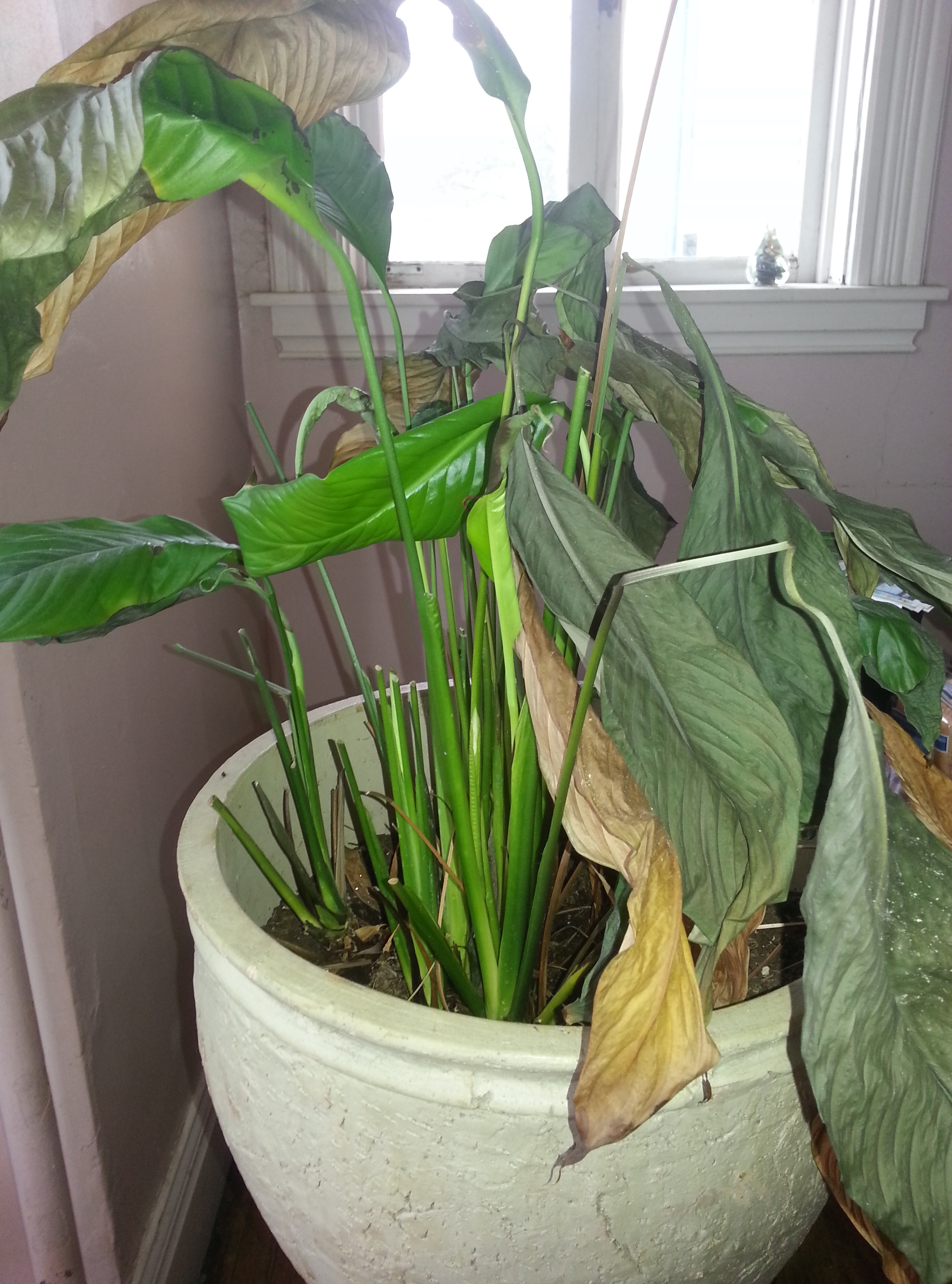
Ask the Expert: I recently acquired a peace lily from my brother's funeral. I would like to know how to prone the plant once a flower blossom dies. I want to keep the plant looking nice. Your care instructions doesn't say where to cut the flower off at. Or do I just leave it alone and let the stem die too and then pull stem and all out at once. Thank you.    Grace

Plant Expert Reply:

You can leave the stalk and let it die-back on its own, but that makes the plant unsightly.  Follow the stalk to the base of the plant and snip it off.  Removing the spent flowers will keep the plant attractive.  To keep the plant healthy remove the florists wrapping and make sure it is a pot that will allow the plant to drain.  Then keep the plant moist but not soggy.

What Is Insecticidal Soap

Wednesday, July 15th, 2009

Ask the Expert: What insecticide with soapy water do I need to use
My Scheffelera plant has black mites on it and I was told to use a soapy water insecticide. Becky

Plant Expert Reply:

You won't need an insecticide in the traditional sense.  Insecticidal soaps don't contain a traditional "insecticide".  Instead insecticidal soaps are specifically chosen plant or animal oils that are refined into a soap with a similar consistency of liquid hand soaps and at a ratio safe for plants.  The active ingredients are the natural potassium salts and fatty acids of plants or animal oils.

Insecticidal soaps work by disturbing the cell membranes of the insects rather than attacking their neurological system like most insecticides. Insecticidal soap will get rid of several types of insects mostly soft bodied insects. So if you have a problem with aphids, spidermites, thrips or scale, insecticidal soaps are a safe and effective treatment.

You can use a mixture of water and household soap.  However, this method can cause issues for your plants if you don't get the proper water to soap ratio or if your household soap is harsh.  Most local nursery garden centers will carry an insecticidal soap at a fairly resasonable price.  If you want to mix your own insecticidal soap, try a mild hand soap mixed at 1 part soap to 3 parts water. Spray the plant lightly.

Good luck and please keep me posted.