July 31st, 2009 | By: Jamie Jamison Adams
Ask the Expert: where are the seeds on a white bird of paradise?
I want to propagate my white bird of paradise but am unable to get the entire root system of the babies. I've attempted it and not been successful, seeing as how they're too deep in the ground. They stay green for about a week or two then die. Is there a specific time when I should be doing this? I'm thinking maybe the seeds. Are the seeds in the flower itself? If not where? Arcelia
Plant Expert Reply:
To propagate Bird of Paradise (Strelitizia) you divide the root suckers from the plant in the late spring. You want to dig up clumps that have 4 or more shoots. You will separate them into single stems removing the dead leaves & roots. You can wash the roots and even soak them in a bleach water solution (1 part bleach – ten parts water) for ten minutes – this will help with any bacterial problems that can arise. Then you can plant the divisions – be sure they are plant at the same depth as they were originally. It can take up to 12weeks for new roots to form. So be patient. This propagation method will take 1 to 2 years to achieve a mature blooming plant.
You can start Bird of Paradise from seed. However, it will take 3 to 5 years for the seed to become a mature plant. If you plan on harvesting the seeds from your own plant, look for black round seeds that have a fuzzy orange cover on one end. Before you plant them you will need to soften the hard exterior of the seed. Do this by soaking the seeds in room temperature water over night. You will need to also nick the seed before you plant it. Keep you soil moist as the seeds germinate.
Good Luck and let me know how it goes.
July 16th, 2009 | By: Jamie Jamison Adams
Ask the Expert: tiger lilysme mature flowering plants.
i have some tiger lilys and i was wounering if the little black things on the leavs are seeds and if they are when can i plant them. thank you Brantlee
Plant Expert Reply:
If the black things are actually on the leaves axils, they are called bulblets. When bulblets mature and fall to the ground they can sprout into new plants. It usually takes 3 years before these bulblets will become mature flowering plants. However the seeds that form in pods after the blooms dissapear can become mature blooming plants the next year.
If you want to harvest and plant the bublets, collected as they start to fall to the ground. THe best time to harvest is after a few drop to the ground.
June 24th, 2009 | By: Jamie Jamison Adams
Ask the Expert: Golden Pothos propagation question
Hi
I would like to propagate my Golden Photos and I have found a lot of instructions and advice on the web. But my question is:
My plant hasn't branched yet, it's just one long plant, probably almost three feet if you would unfold it. So there isn't a side branch to cut of.
Is it advisable to simply cut of the top of the plant – three or four top leaves (this would leave 13 or 12 leaves on the mother plant)? Would the mother plant automaticly start growing one or more branches afterwards if i did it?
I'm surprised it hasn't branched yet. I got the plant from a friend half a year ago – he had had it in his bathroom and it had only about five sorry looking leaves on it. Now it look really healthy and perky, but it anoys me a bit that it's just one long snake – that it doesn't split itself.
I've been redirecting it towards the soil surface, so that it could re-root itself ith every new length (because it looked like it needed it). I'm wondering if doing his could have caused it to not branch – the fact that it never grew more than five new leaves away from the latest firmly rooted root. Shold i stop doing this in that
case?
Thanks
David
Plant Expert Reply:
Redirecting the plant as you say is one form of propagation. Once those section have a strong root system you can cut them off the mother plant and you have a new plant. When you cut it off the mother plant both plants will start to form new leaves. You can also propagate a new plant by taking a leaf with a node and stick the node in the soil. You can do this multply times from one long runner. By doing this you will encourage more growth from the mother plant and often lateral grow as well. Many times the plant will begin to form roots at the nodes on their own. This makes it easy to propagate golden pothos.
The nice thing about pothos is the tolerance of this plant. You can cut, abuse it or ignore it and it will still live. I personally find that trimming my pothos makes it healthier and thicker. Sometimes I will start new plants from my cuttings and other times I don't bother with it. The one thing I do when propagating these plants it to keep the soil moist when the roots are forming.
Good luck and let me know how it goes.
April 6th, 2009 | By: Jamie Jamison Adams

Red Margin Draceana
Ask the Expert: What type of Plant is this
I have had this plant for some time now and I would like to know what it is. I am looking to see if I can possibly re-plant it shortening the trunks. I don't like how deadish it looks and so empty on the stalks. Any help would be greatly appreciated. Please let me know if you were able to view the pictures. The top leaves seems to be healthy but the bottoms don't seem as colorful. Most are falling off dead.
Lisa
Reply:
What you have is a Draceana marginata also known as Madagascar Dragon tree or Red-edge Draceana. You can shorten the plant and create new ones at the same time. First cut the stems to the height that you want the plant to be and leave alone for a couple of days. Then mist the air around the plant every few day. Make sure to water your plant as you always have. In a few weeks the stems will put out new foliage. In the meantime, you can take the tops that you cut off and dip them in rooting hormone and place them in a pot with moist soil. Keep the soil moist but not soggy in a few weeks the plants will start to form new roots.
Good luck and keep me posted.
April 6th, 2009 | By: Jamie Jamison Adams

Flamingo Flower
Ask the Expert: How do I split My flamingo plant
It is very large & has been repotted several times – is it possible to split it without causing to much damage. Elaine
Reply:
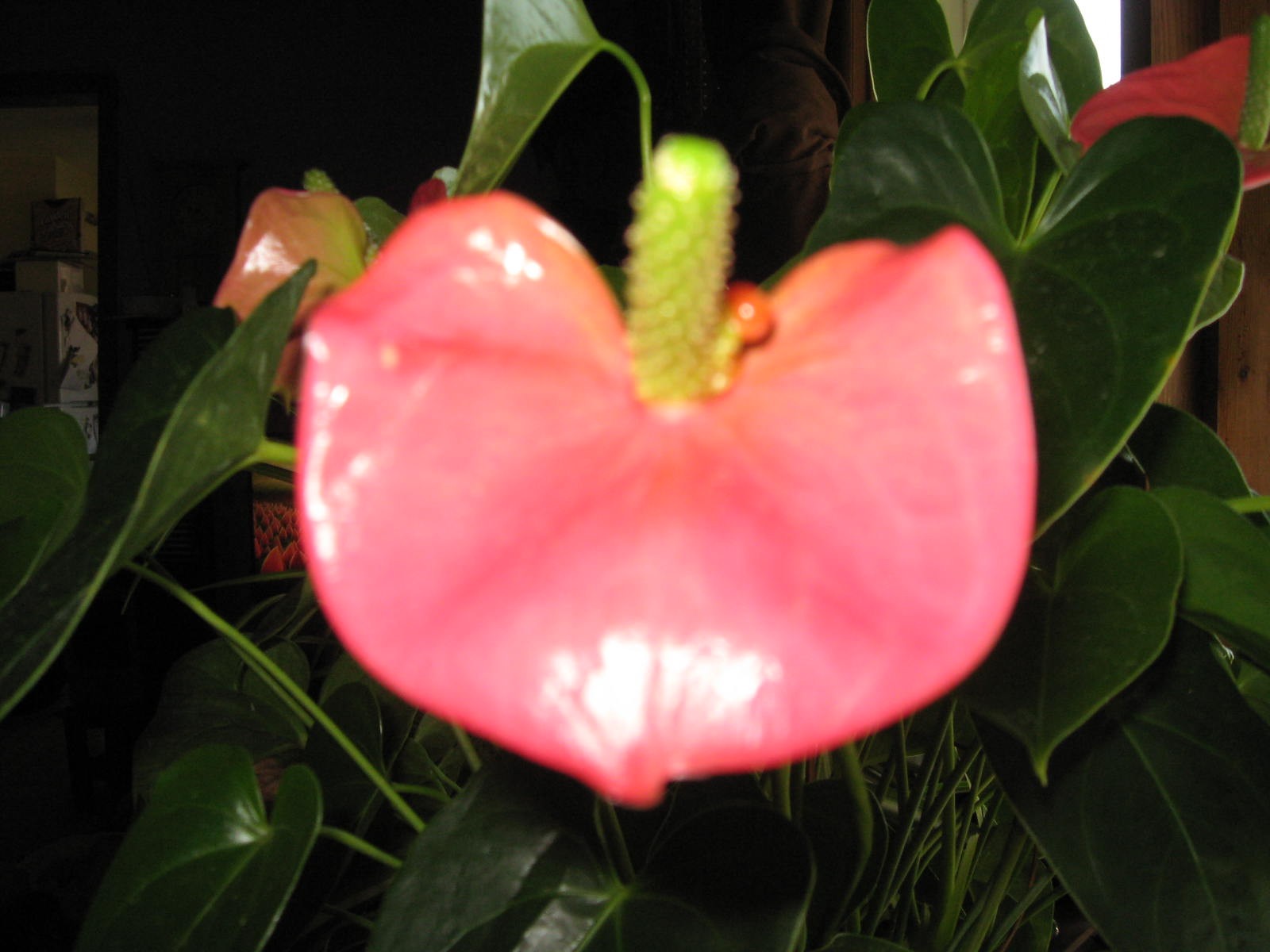
Anthurium (Flamingo Flower) can be propagated by division. You will need to remove the plant from its pot. Check for any off-shoots or ariel roots. These will be plant that are attached to the main stem but can easily be remove and still have a complete root foliage system. Some people refer to these as "babies". You will remove them from the main stem and pot them in the same kind of soil as the parent plant. Care for them the same as the parent plant. I would not recommend splitting this plant in half.
March 30th, 2009 | By: Jamie Jamison Adams
Ask the Expert: how can i start another sansevieria from one that i I want to start another plant off of the one I already have. How can I do that? joni
Reply:
There are two methods by which you can propagate sansevieria.
1) Separate a sucker from the main plant or divide the rhizome. I do this by removing the plant from the container. If I see a sucker (a piece that looks like it is slightly separate from the main plant), I cut it away from the main plant. I then take the sucker and pot it. Be sure to pot it the same level it was originally. You can also simply divide the plant by taking a knife and from the bottom cut upwards towards the foliage until a piece separates from the main plant. Then you can pot this piece.
2) Leaf cuttings are another way to propagate sansevieria. However, leaf cutting will take longer and are not always successful. For leave propagation you will need a piece about three inches in length. Start at the tip of the leaf and go three inches down. Now cut the leaf horizontally and take the three inch piece cut side down and dip into rotting hormone. Then place the piece in moist soil. Be sure to keep the soil moist but not soggy until the roots form.
Good luck and keep me posted.
March 23rd, 2009 | By: Jamie Jamison Adams
Ask the Expert: Peace Lilly out growing pot
I have a peace lilly and have had it for about 11 years (one of the few I haven't killed) and I have it in a huge pot but it seems to be growing close in I want to know how can I separate the plant, it has a huge root ball and replant to give it more room to grow to it's full potential? Sandy
Reply:
Although peace lilies like to be a little root-bound, you should re-pot or split them when the roots overflow the container. It seems your peace lily is definitely overgrowing its container. In your case, I would split the plant rather re-pot it. You will need:
- Pot (around the same size as the one it is now)
- Potting Soil (a good houseplant potting soil)
- Large Serrated Knife
Begin By removing your plant from the container. Don't worry about tearing the roots or losing a few leaves. Lay the plant on its side. This will give you a view of the root system as well as the foliage attached to the rootball. Now you are going to cut the plant into two pieces.
To do this, take the knife starting at the bottom of the rootball and work it back and forth until you have made a cut all the way to the foliage. Now you should have two separate peace lilies. Each one will have foliage attached to a portion of the rootball.
Now place one of the peace lilies in the center of the original container. Be sure the rootball is at the same depth it was before the plant was split. Then add soil to close the vacant space in the container. Be sure to water it when done. This will get rid of any air pockets that have formed around the roots.
Now pot the other peace lilies in the new container. Once again, make sure the rootball is planted at the same depth as it was in the original pot. Fill in the vacant space and water.
These plants will go through a little transplant shock and may wilt. Resist the urge to pamper them. Instead, place them in the same environment as before and water accordingly. In a couple of weeks, you will have two thriving peace lilies.
Good Luck and keep me posted.
May 2nd, 2008 | By: Jamie Jamison Adams
Ask the Expert: how and where do you snip the flower for replant one is a golden pothos, other is a parlor palm i want replant.
Laura
May 1st, 2008 | By: Jamie Jamison Adams
Ask the Expert: Planting Lavender
Hello,
I received a Spanish lavender plant in the mail as a gift. It looked great when I got it, but after replanting it in a larger pot, slowly died despite a lot of attention (water, sun, etc.). I've grown lavender before, but never had this much trouble (I live in a warm, Mediterranean climate, and it's been fairly warm). I kept the pot inside in a windy at first, then moved it outside thinking it needed more sun.
Could you please explain how best to transplant this replacement so that it fares better? I just used a regular potting soil mix before, and a larger terra cotta pot.
One thing that I think might be the culprit– there are some above-soil roots (I think)– should those be planted above or below the soil line in a new pot?
Thanks! Photos are attached so you can see the roots I am describing.
Kami