Home Shop Flowers Bloomin' Blog Find Florists About FSN Contact FSN Florists Only!
Find Your Local Florist:
Home Shop Flowers Bloomin' Blog Find Florists About FSN Contact FSN Florists Only!

Member Florist wins Civic Award

Bamboo Orchid - Poteau, Oklahoma StorefrontOklahoma Florist Wins Civic Award

New businesses, take note: it’s not just the established florists that get local accolades.

Glenda Wise of The Bamboo Orchid recently received the Civic Improvement Award (in the Small Business — New Construction category), for Poteau, Okla., as well as citations of congratulations from her senator and congressional representative, only a year after opening her doors in January 2006.

“Her business was judged on … the overall appearance, inside and out,” says Bonnie Prigmore of the Poteau Chamber of Commerce.

Wise says of her open-plan interior: “I believe the al fresco designing lets customers see creativity at work.”

Wise, however, suspects her unique design style and excellent customer service contributed to her winning the award, which she received at the annual Chamber of Commerce dinner in February.

“I think that for people who aren’t necessarily exposed to a lot of different design styles, we offer them something else — something they wouldn’t normally get,” Wise says. “In crunch time we always make something work for the customers.”

She also hopes her award will prove to customers that she is in it for the long haul: “I feel like a lot of new things don’t stick around,” she says. “But this award shows that we are here to stay.”

–Vanessa Machir vmachir@safnow.org Reprinted courtesy of Society of American Florists E-Brief Newsletter

What to do with my peace lily.

Ask the Expert

My husband and I recentley aquired a peace lilie follwing a funeral. Therefore there were no instructions and it is already quite large. I planted it outside and now I am a bit concerned that they are house plants only. Please help! It is very sentimental and was hoping someone could let me know if it can survive outside?
Amye

I think my lucky bamboo got too much sun.

I recently moved and my lucky bamboo was in the back of a truck where I
think it got to much wind and sun. The leaves are yellow and splitting on
the ends. How to I make him healthy again Cissye

Identify This Plant?

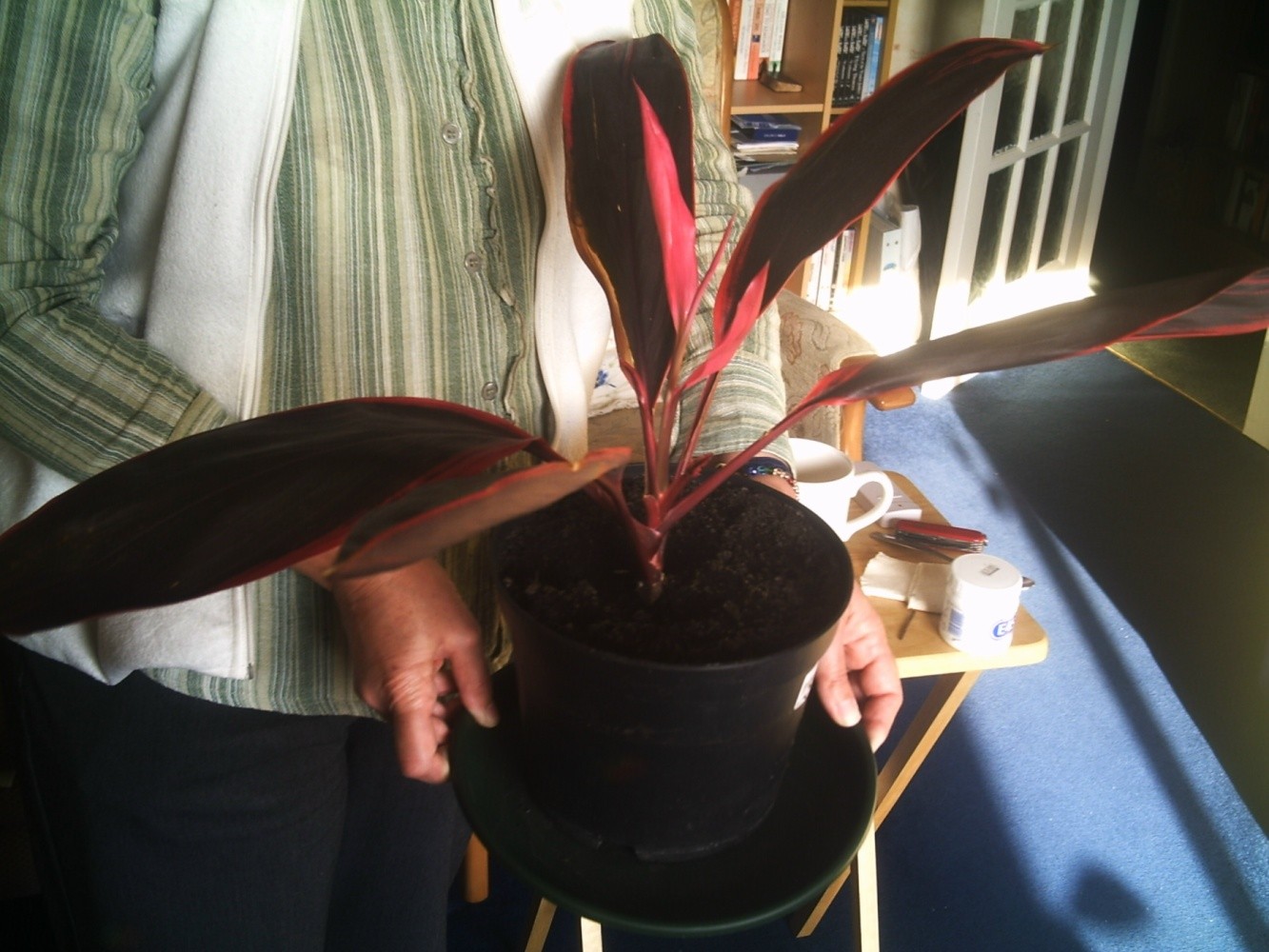
Ask the Expert: Can you identify this plant for me?

My wife found this in a bunch of flowers, it had a good root system on it so she planted it in a pot and it has started to grow! Thanking you in advance. Stephen Ward.

Unidentified plant

Will A Peace Lily Survive Outside In Canada

My daughter bought us several Peace Lilies. She was under the impression that they could be grown outside in the garden. Is this possible. We live in Manitoba, Canada where the winters are fairly severe.
Joel

The Language Of Flowers

Photo of Kate Collins - Flower Shop Mystery Series Author
“Belladona: A flower. In Italian, a beautiful lady; in English, a deadly poison”. Ambrose Bierce, The Devil’s Dictionary

During a question/answer session in a speech I gave to a college media class last month, a student asked why I’d chosen a flower shop as a backdrop for my mystery series. My quick response was that I liked flowers and I loved flower shops — the colors, the textures, and ah, those heavenly fragrances… But still, mixing murder with something as vibrant and alive as a flower? Isn’t that as unlikely as chocolate sauce on an omelet? (Yumm . . . Chocolate.) Okay, maybe that was a bad example.

Being the argumentative type, (a genetic trait common to most women) I had to come up with a good rebuttal. So basically it’s this: Who can think of a black orchid without visualizing intrigue — or the book or movie, The Black Dahlia, without thinking of murder? Who can picture a Venus fly trap without recalling Audrey II, that voracious man-eating plant in the cult favorite, The Little Shop of Horrors? And we haven’t even started to list the poisons that come from various plants, the castor bean plant being one.

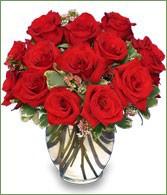
Bouquet of Red Roses
But that got me to thinking about the other side of the coin. Who doesn’t associate red roses with love? Or white flowers of any kind with purity? A google search on the meaning of flowers produced a plethora of pages (5,270,000 to be exact) dedicated to that subject, which got me to wondering where this custom of equating feelings with flowers originated.

According to my research, floriography, or the language of flowers, was an important part of Victorian life, (roughly 1870-1901) allowing expressions of sentiment that could not be otherwise vocalized due to the rigid moral standards of the day. (They must be turning in their graves now.)

Flowers were used to adorn hair, clothing, men’s suit coats, home décor and stationery, to name a few.

A young man’s gifts of flowers could either please or displease a lady depending on his choice of blossom. Flowers conveyed love or dislike depending upon the type, size, how they were held, or even how they were grouped. Even the way in which flowers were delivered had a special meaning. A flower in an upright position represented a “positive thought; one presented in the opposite direction had a negative meaning. A flower offered by the right hand could signify a “yes” and one offered by the left hand a “no.”

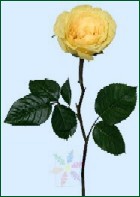
Single Yellow Rose
One can understand why the wily Victorians referred to books such as flower dictionaries and herbals that recorded the virtues of plants as well as their myth and lore, in order to choose just the right blossom. Consider the language of roses alone:

Blue: mystery
Burgundy: beauty
Dark Pink: gratitude
Light Pink: admiration, sympathy
Orange: passion
Pink: grace
Red: love Yellow: dying love or platonic love or infidelity

Going back even further, literary annuals were being published as early as 1765, in France, and 1770, in Germany, and reached their peak of popularity in Europe and America from about 1820 through mid-century. But, as I discovered, there is much debate about the exact origins of the flower-sentiment associations.

Floriography appears to be based on ancient symbolic correlations taken from Chinese, Japanese, Middle Eastern, Greek, and Roman cultures, mythologies, and religions; possibly based on the actual physical description of the plants themselves — a distinguishing characteristic of the root, stem, leaf, bloom, or seed. One of the most frequently mentioned sources is the Turkish, Oriental, or Persian language of flowers or objects, referred to as the selam, which was in fact a system of memorization. Brent Elliott, Librarian to the Royal Horticultural Society, writes that the Turkish system was “not a language of meanings, but a mnemonic system – the names of the objects rhyme with standard lines of poetry, and are an aid by which the lines can be recalled.”

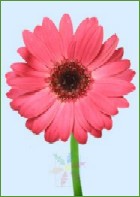
Single Pink Gerbera Daisy
But the meanings we associate with flowers today are actually a fairly modern invention used most often by poets, writers, artists, and designers. Indeed, literature itself may be credited with promoting the language of flowers, as you can see in the works of Shakespeare.

However, there isn’t one universal set of meanings because of the significant cultural differences concerning the types of sentiments and flowers in the vocabulary of the various countries of origin. Take these three flowers as typical examples of the diversity of meanings:

Daffodil – Respect; regard; unrequited love; deceit
Dahlia – Good taste; instability
Daisy – Innocence; loyal love; purity; faith; cheer; simplicity

If you are interested in finding out more about the language of flowers, visit Flower Shop Network Flower Meanings. In the meantime, by using a different floral theme for each of my mysteries, I am doing what writers through the centuries have done – inventing my own floriography. It’s not such a bad thing to be known for, is it? I’ll take one bouquet of blue roses, please.

Kate Collins writes the popular Flower Shop Mystery series, including MUM’S THE WORD, SLAY IT WITH FLOWERS, SNIPPED IN THE BUD, and ACTS OF VIOLETS (March, 2007). Kate’s next book in the series, A ROSE FROM THE DEAD, will be a December, 2007, release. Visit Kate at Kate Collins Books.

Show someone you care … Send flowers today. Find A Florist to help you express yourself.

Language of Flowers Newsletter (Guest Writer Kate Collins)

I thought I would let everyone know that Flower Shop Network has a special guest writer (Kate Collins the talented author of the Flower Shop Mystery series) for the April newsletter “The Language of Flowers”. Kate gives us insight to where flower meanings come from. For a sneak preview of “The Language of Flowers”

go to

Language of Flowers

To learn more about Kate Collins goto www.katecollinsbooks.com and don’t miss the release of her next book Acts of Violets.

Easter Lillies and Cats Do They Mix?

“The National Animal Poison Control Center says that certain types of lilies can cause renal failure in cats that have ingested any part of the lily. Flower Shop Network recommends keeping lilies out of the reach of cats. It is important to note that lilies do not pose a problem for other pets or humans.”

Why Is My Gerbera Plant Sick?

What is wrong with my Gerbera?
It sits on my desk and gets fluorescent lighting only. It was full of blooms only a few weeks ago. Can you help me? Here are some pictures of the plant.
Tracy

Damaged Gerbera leaf Sick Gerbera plant

What To Do If Lucky Bamboo Has Root Rot?

Can you tell me what to do if my Luck Bamboo gets root rot? I had it planted in the vase I purchased it in and I noticed it was not doing well so I transplanted it to a bigger vase. When I moved it the smell was bad! Can this be saved?

Christy