Home Shop Flowers Bloomin' Blog Find Florists About FSN Contact FSN Florists Only!
Find Your Local Florist:
Home Shop Flowers Bloomin' Blog Find Florists About FSN Contact FSN Florists Only!

Fruit, Gourmet & Custom Gift Baskets

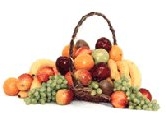
Fruit BasketThe popularity of fruit and gourmet gift baskets has increased substantially over the past several years, and more and more full-service florists are offering wide selections of gifts to complement their fresh flowers. It used to be that a simple basket full of apples, oranges, grapes and the like was the most interesting fruit basket choice available. But supply and variety have happily increased to meet demand such that, today, gift baskets can be custom-created in any theme you can imagine…..and these gourmet baskets deliver so much more than just fruit.

Choosing The Right Gift Basket

  • Coffee-lovers

For the caffeine-lover in your life, send a coffee gift basket, brimming with interesting and exotic coffees and condiments, aromatic whole beans and an electric grinder, a pair of special mugs, fancy napkins, some delicate cookies, and a CD featuring music of the coffee-growing regions of the world.

  • Day At The Spa

Pamper someone who is in need of a little luxury with an at-home “Day at the Spa” collection of bath and body products. These gift baskets can include scented bath oils or bubble bath, handmade soaps, skin lotions, a loofah sponge and body sprays. Add an aromatherapy candle to heighten the sense of relaxation.

  • New Baby Gift Basket

For the parents of a newborn child, send a bassinet basket of baby gifts. Tuck in a rattle, some tiny socks or booties, a spoon and a bib, a miniature T-shirt, baby powder and lotion, a bottle of aspirin for Mom, and for Dad, some bubble-gum cigars. Don’t forget a cuddly, plush teddy bear for the newborn. Have a congratulatory balloon tied on to add buoyancy to the celebration.

  • Dog Lovers

Is one of your canine friends feeling blue? Send a dog-themed gift basket of yummy treats, a new collar and leash, a cute squeaky-toy and a chew bone, all wrapped up in a big, new dog food dish. Trends forecasters say that, with declining birth rates in the U.S. and the increase of single-person households, pets are the “new children.” (I wonder what happened to the old ones.) Surely, you know someone who is especially fond of their pet.

  • Gourmet Gift Basket

Gourmet assortments of imported jams and jellies, pungent cheeses and creamy pates have become almost commonplace. But not every fruit or food basket needs to be filled with gourmet items. Surprise your favorite sports fanatic with a gift basket overflowing with junk food snacks like potato chips, pork rinds and pretzels. Toss in some bite-size Snickers bars, a can of squeeze cheese and saltine crackers, and let the snack-fest and games begin! Don’t forget to include the antacid tablets!

  • Seasonal Gift Baskets

Seasonal gift baskets are always popular choices, with selections tailored for a specific time of year or upcoming holiday. A gardener‘s trug containing gardening hand tools, gloves, seeds, knee pads and sunscreen makes a useful and thoughtful gift in spring. Summer might suggest a day at the beach, with a collection of beach toys, a beach towel, a bottle of sun tan lotion, and a couple of pulpy paperback books all delivered in a large plastic pail. Autumn evokes the gustatory pleasures of the harvest season…..grapes, apples and other fruits, nuts, cider mixes, a fresh-baked pie or loaf of herb bread. A Christmas-time basket could include a special Christmas tree ornament, candy canes, a tin of holiday cookies, a scented candle or potpourri, a CD of carols….even a pair of festive mittens!

  • Graduation Celebration

Now is the perfect time to honor a recent graduate with a ‘Congrats #1 Grad’ gift basket! A professional florist can help you create a customized array of unique and practical gifts that a high school or college grad will enjoy. Fill a ‘Class of 2004’ keepsake mug with Jolly Rancher candies or bubble gum and nestle it in a basket loaded with munchies like microwave popcorn, sunflower seeds and Pop-Tarts. Personalize your congratulations basket even further by adding a prepaid phone or gasoline card, book of stamps or pens and pencils. Just right for memorable snapshots with class buddies in caps and gowns or ‘best summer ever’ photos are disposable cameras, mini photo albums or mini picture frames. Have your local florist assemble the gifts into a re-usable basket, all tied up with ribbon in school/college colors, and deliver it to a graduate that’s in a class all of their own!

You are sure to get rave reviews for creativity when you surprise a friend or loved one with a brightly-packaged basket chock-full of all his/her favorites! Remember, next time an occasion arises call your professional full-service florist for an extra-special delivery of fresh flowers, along with a fruit or gourmet gift basket.
The Art of Bonsai

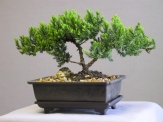
For centuries, people the world over have been fascinated by bonsai (pronounced BONE- SIGH). These carefully trained trees and shrubs captivate the imagination, as they seem to be impossibly old for their small size, all the while appearing to be exact, miniaturized replicas of mature, full-sized specimens.

The term bonsai’ is a Japanese word made up of two characters: bon’, meaning tray, container, or pot, and sai’, which means tree or planted tree. Thus, bonsai’ may be best translated as “tree planted in a tray’ (to say “bonsai tree” is redundant). The word is both singular and plural, and though they occur in a variety of sizes and shapes, bonsai are always in pots. The practice of growing bonsai originated in China thousands of years ago, but has been truly perfected by Japanese masters.

A typical bonsai is usually a deciduous or evergreen tree which has been maintained at a size between ten and thirty inches tall, although smaller and larger sizes are common. These trees are carefully pruned, trained, potted and coddled so as to maintain their dwarfed size despite ever-increasing age. Age, of course, adds character…an aesthetic quality which bonsai enthusiasts strive for. The older a tree is, the better. There are bonsai specimens living today which are literally hundreds of years old…trees which have been handed down from generation to generation, or which have adorned the entrances to temples or palaces, or which have been official gifts to heads of state. Some bonsai have been trained to resemble ancient and nearly- dead evergreen trees, weathered and beaten by the elements while clinging to a windy cliff. Others are planted in groups which call to mind the stately serenity of a primaeval forest. A solitary, gnarled and statuesque tree may seem to hold the history and the wisdom of the ages.

Bonsai TreeBonsai care depends on what species the plant is. Traditionally, bonsai have been created of trees from temperate climate zones, like Japan, with a regular cycle of changing seasons. Various species of pine, spruce, and small-leaved elms and maples are typical. Caring for these trees requires growing them out of doors and duplicating their native environment. Because they are normally planted in relatively small or shallow containers, good care requires frequent watering (sometimes several times a day) during the growing season. In the wintertime, these bonsai are frequently placed in a cold frame to protect them from drying winds and extreme temperatures while providing a necessary and chilly dormancy. These plants should never be kept indoors for very long periods of time.

Many tropical and subtropical plants, including some common houseplants, lend themselves to being good bonsai subjects as well. Popular varieties include ficus and pomegranate, among others. These trees require the normal care for their species, keeping them warm and well-watered virtually the year round. In all cases, frequent pruning and shaping is necessary to maintain the shape and character of the plant. Because bonsai are often grown in shallow pots or trays, regular re-potting and root pruning is essential as the plants deplete the nutritive value of the potting soil.

With proper care, bonsai can live for generations, just as any normal size tree. They can become like members of the family. There is a spectacular collection of bonsai specimens at the National Arboretum in Washington, DC, which is well worth a visit. Your professional florist may be able to source some kinds of bonsai for you, but it’s probably more useful to consult a nursery which specializes in such plants. Local bonsai clubs may be located through your area botanical garden, and they typically sponsor shows where bonsai may be viewed or purchased.

Take some time to experience the beautiful art of bonsai.

Daisies, Daisies and More Daisies

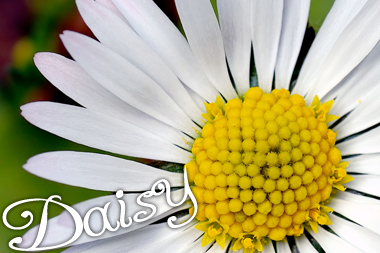
Daisies are among the most well-known and popular flowers of all, and for good reason: who can resist a fresh bouquet of cheerful, sunny faces and delicate petals? Charming harbingers of spring, daisies will bring a smile to anyone’s day.

Lazy Daisy and Delphinium Flower ArrangementDaisy Fresh

Daisies have long been associated with youth and purity, hence the phrase “fresh as a daisy”. Wedding bouquets with daisies would certainly be appropriate for a young bride or her attendants. In Victorian times, when hidden meanings were associated with many flowers (see our June  Newsletter, The Symbolic Meanings of Flowers), daisies signified innocence and gentleness. Perhaps it is these qualities which makes them such good fortune-tellers (“…she loves me, she loves me not, she loves me”)! Today of course, we often think of sending daisies whenever we want to cheer someone up.

Types of Daisies in Flower Arrangements

The flowers which are most often sold as daisies in modern flower shops are usually a daisy-flowered type of spray chrysanthemum, or daisy pompon as it’s known in the trade. Occurring with several flowers to the stem, these daisy pompons are sturdier and longer lasting than traditional Marguerite daisies, and are available in a wide range of colors and sizes.

Gerbera daisies, originally native to South Africa, have become enormously popular in recent years, and they’re being used in everything from casual vase arrangements to sophisticated wedding bouquets. Hybridizers have succeeded in developing gerbera daisies in a tremendous variety of sizes, textures, and colors; there is a gerbera which will coordinate with virtually any decorating scheme or wedding theme.

Where To Buy Daisies

As always, your local professional florist can guide you in selecting the right daisies for the right occasion. Buy them for yourself or for someone else… no one could ever send a bad message with daisies. Just please don’t eat them! But that’s a tale for another day.

History of Valentine’s Day

Cupid’s arrows will soon be flying, because February 14th, Valentines Day, is the time when romance is all around. By long established custom, it’s the day when friends, spouses, lovers, and intended lovers around the world typically proclaim their affection with cards, gifts, and of course flowers! But have you ever wondered about St Valentine’s history? Who was this mysterious figure whose name has come to be so closely associated with affairs of the heart?

Valentine’s Day History

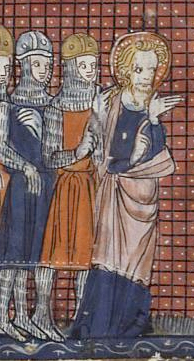
St. Valentine - from History of Valentine's DayThe legends surrounding St Valentine’s history vary, but the most popular and probably most credible story identifies St Valentine as a third century Roman priest. At the time, Emperor Claudius II was having trouble recruiting young men for his army. The emperor outlawed marriage, believing that young men would be more willing to join the army if they did not have wives and families waiting for them at home. Valentine (or Valentinus, as he would have been known in Rome) defied the emperor and continued to marry young lovers in secret. When his actions were discovered, he was jailed and sentenced to death.

Other stories suggest that Valentine was executed for attempting to help Christians escape from the harsh tortures of the Roman prisons.

As history tells it, Valentine became friendly with the young daughter of his jailer, and on the eve of his execution, he left her a tender note which he had signed “from your Valentine”. Thus, he became a heroic, sympathetic, and romantic figure, who may well have “sent” the very first valentine greeting himself. His martyrdom poised him for sainthood.

Why Is Valentine’s Day In February?

Some believe that the date in mid-February commemorates St Valentine’s death or burial, around 270 A.D. However, in ancient Rome the pagan festival of Lupercalia always began on the Ides of February, the 15th. Lupercalia was a celebration of fertility and the beginning of spring, and part of the festivities involved placing the names of eligible young women into a box or an urn, from which the young bachelors would draw. These pairings would last at least for the duration of the festival, or perhaps for an entire year, and the couples frequently married. Early Christians, in an effort to remain inconspicuous, regularly co-opted existing pagan celebrations and made them their own. In approximately 498 A.D., Pope Gelasius proclaimed February 14th as St Valentines Day, establishing the date for all history. Later, during the Vintage Valentine's Day CardMiddle Ages, it was commonly believed in Europe that February 14th was the beginning of the birds’ mating season, further linking the date with romance.

Valentine’s Day in Modern Times

St Valentines Day was being popularly celebrated in Great Britain by the 17th century, and Americans probably began exchanging handmade valentine greetings in the 1700s. The first mass-produced valentines in America appeared in 1840. The rest… as they say… is history. Naturally, those first valentines were appropriately decorated with doves (who are said to mate for life), hearts ( the universal symbol for love), and images of Cupid ( the son of Venus, the Roman goddess of love).

Your Valentine’s Day…

These days, what could be a more perfect expression of what’s in your heart than beautiful fresh flowers, artfully arranged and deftly delivered by your professional florist? Whether your valentine is close to home or far away, your local florist can help you make some valentine history of your own. Be sure to order early for best selection and delivery options. Then, step back and let Cupid’s arrow find it’s target!

A Nightmare Before Christmas? Last Minute Decorating Ideas

If the thought of decorating for the holidays is giving you a nightmare (after all, there are just a few weeks left before Christmas arrives), then pay a visit to your local florist for some up-to-the-minute advice and inspiration. Holiday merchandise is now appearing in flower shops everywhere, ready for your approval.

Christmas’ ‘Hottest’ Colors

One of the Christmas decorating trends this year is the use of hot colors; think of the day-glo hues of the Sixties. It’s a retro look, evoking a spirit of nostalgia among those of us who lived through it the first time. Hot pinks, greens, and oranges are finding their way onto Christmas trees and wreaths, creating a youthful and festive exuberance.

Mod Christmas Style

Ornaments are being created in the “mod” geometric forms of the era; you know…. the shapes of those triple light fixtures hanging in your mother’s kitchen. They’ve been decorated in polka dots and wavy stripes, and sometimes even flocked. If you can’t afford a whole new collection, then simply adding a few new ornaments or a bit of splashy new ribbon can update your older arrangements and give your Christmas decorating scheme a fresh appearance.

New England Themed Christmas TreeNatural Christmas

At the other end of the Christmas decorating spectrum is the natural look, which features such rustic elements as branches, cones, pods, and feathers. Colors are muted and textures are emphasized. Woven baskets or bark-covered containers may be used to hold an assemblage of earthy finds, such as cinnamon sticks, dried flowers, or an empty bird’s nest. Artificial pine Christmas wreaths may be encircled with dried grapevine to provide texture and movement. Add dried mushrooms, pomegranates, spruce cones, and lotus pods to the wreath to create a lush, woodsy collage of nature. Such a design is also appropriate for the fall of the year, and even beyond holidays, into the winter. This “trans-seasonal” approach to decorating can save time and money.

Bringing It All Together

If you want to decorate like the professionals, select a theme for your Christmas decor and re-interpret it throughout your home or office. Unify all the decorations by duplicating a specific motif — such as holly berries or candy canes — and by repeating a certain ribbon pattern or ornament style. And when it comes to decorating Christmas trees, remember that depth is important. Christmas trees ought to appear full and abundant. Place larger ornaments well to the inside of the branches in order to draw the viewer’s eye inward while creating a background for the other, smaller ornaments at the surface. This gives the tree a greater sense of volume. Use wide ribbon or swags of lightweight fabric as a garland to spiral around the tree and to occupy space. Consider purchasing ordinary, inexpensive glass ball ornaments as filler for the center of the Christmas tree while bringing the more unique and precious ones forward.

With the help of a professional floral designer, you can turn your nightmare before Christmas into a decorating dream come true. Stop in today… you’ll sleep easier.

Interior Decorating Ideas with Flowers

Flowers and plants, naturally enough, bring a sense of warmth and vitality to any interior decorating plan. People respond positively to the energy that flowers and plants emanate. Even silk flowers, or permanent botanicals as they are more properly called, can add life to a room if they closely resemble their living counterparts. A room devoid of flowers is sterile and dull, even uninviting. But just a few well-placed blossoms or a handful of green foliage can do wonders for the personality of any interior space.

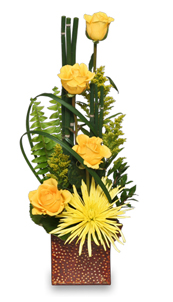
Good as Gold Flower Arrangement

Flowers For The Entryway

The first place to start is at the entry, where visitors may be greeted by a bouquet of cheerful flowers placed on a credenza in the foyer. It makes no difference whether the arrangement is simple or elaborate; the message is the same: “welcome.” Other interior decorating ideas for the entry include placing vines of artificial ivy over a mirror, or flanking the doorway with wall sconces overflowing with foliage. Of course, the entry experience begins outside the front door, where a seasonal wreath or a floral swag creates an inviting statement.

Choosing Flowers For The Home

Within the interior of the house, use flowers to adorn the coffee table, dining room table, or end tables. Choose colors which complement the decorating scheme of the room. However, don’t be locked into the idea that the colors of the flowers must match those of the upholstery or draperies, especially if they are colors which do not normally occur in nature. Permanent flowers will always be more pleasing, and they will never go out of style, if they are realistic and botanically accurate. For example, you’ve never seen a turquoise rose growing in a garden. Placing one in your living room would seem contrived and unnatural, and you would soon tire of it even if your sofa was that color. Better to use a flower in a peach or coral hue, which is the direct chromatic complement to turquoise and a naturally occurring color for roses. Choosing the complementary hue allows the flowers to stand out as a lovely accent to highlight the room.

Using Garland & Greenery Effectively

Use cascading vines for decorating the top of a bookcase or an armoire; they’ll soften the angular edges of the furniture. A garland of magnolia foliage lends grace and elegance to a mantle. A free-standing houseplant brightens a dark corner. The breakfast table is brightened with a sunny bouquet of daisies.

A novel interior decorating idea is to tie a bunch of realistic permanent flowers into a casual bouquet, using a distinctive, wire-edged ribbon. Choose flowers with natural looking stems and foliage. Arrange the flowers so that the bouquet is flat on the back. Tie the bow with long, flouncy streamers, and place the bouquet on the edge of a table or dresser for a spontaneous and understated look.

Your local professional florist has lots of other ideas for interior decorating with flowers. Stop in for a visit today, and bring samples of colors, fabrics, and wall coverings from your rooms, so that your floral designs can be artistically customized to your living environment. And remember… no turquoise roses!

Decorating Ideas For A Wedding Reception

What is true of nearly every wedding is the fact that the guests spend far more time at the reception than they do at the ceremony. So when it comes to flowers, the astute bride will focus more of her attention, and her budget, on decorating the wedding reception. The ideas are as varied and unique as each individual bride, but the primary goal is always the same: to provide a happy and memorable experience for the guests and the bridal party alike. And flowers are, of course, the obvious choice for creating a festive and celebratory mood.

Find Your Reception Theme & Stick With It

Among the most important ideas in decorating for a wedding reception is to establish a specific theme and stick with it throughout the venue. This may be based on a particular color or color harmony, or a certain motif, such as a heart or a fleur-de-lis, which is repeated in all the decorations. Very often, the color scheme is related to the color of the bridesmaids’ dresses; when the attendants enter the room, they complement the environment with their colorful presence. Tablecloths, napkins, and flowers are then selected to coordinate with the gowns. It is important to consider the existing colors in the room as well, even when it comes to selecting the bridesmaids’ dresses.

Reception Entryway Flowers

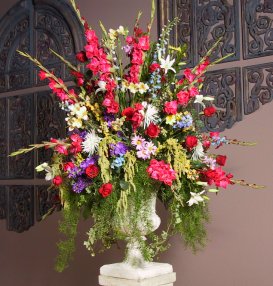
Decorating Ideas For A Wedding ReceptionThe wedding guests’ entry experience will greatly influence their mood at the reception. This is an area which should be emphasized for maximum impact. Decorating ideas include hanging garlands of fragrant blossoms over the doorway, flanking the entrance with grand floral arrangements or masses of foliage plants, hanging heart-shaped wreaths of flowers on the doors, swagging fabric overhead, or strewing the floor with rose petals. Miniature twinkle lights can certainly add to the festive atmosphere, and may be incorporated into trees or garlands.

Free-standing Flower Arrangements

Free-standing floral arrangements, strategically positioned around the room, can contribute greatly to the wedding reception decorating plan. One idea is to stuff the canopy of a rented ficus tree with flowers, creating a large-scale floral topiary. Or place extravagant, cascading flower arrangements atop tall columns, which may be situated among the tables or around the dance floor. These large scale designs can do a lot to dramatize the room, and create a sense of intimacy among the guests.

Decorating The Wedding Cake Area

The wedding cake is a primary focal point at every reception, and should be decorated accordingly. Stage the cake in a prominent position in the room, on a special table of its own. Consider creating a backdrop of foliage, flowers, screens, or fabric, since this will be a setting where many photographs will be taken. Drape the table in layered linens to emphasize the importance of the scene, and elevate the cake on a large platter or silver plateau to make it more prominent. Of course, fresh flowers will always enhance the wedding cake itself as well as the table. One lovely decorating idea is to position the cake on top of a clear glass disk, perhaps 24″ or 30″ in diameter, which is supported by glass bricks. Fresh flowers can then be arranged beneath the cake, gracefully spilling out onto the table from under the glass as the cake seems to float.

Reception Finishing Touches

To add a charming and sentimental personal touch to the wedding reception decor, place framed photographs of the bride’s and groom’s parents from their own wedding days on the cake table or the guest book podium. It’s a loving expression of heritage and gratitude.

The individual guest tables provide unlimited opportunities to personalize the reception decorations. Consider clustering several small vases of fresh flowers into a larger composite centerpiece. Guests can then take the individual bouquets home as a memento of the happy event. Placing the vases atop mirrors, and interspersing votive candles and glass gems, adds a dimension of sparkling light to the completed tablescape.

Your local florist has lots of other creative decorating ideas for a wedding reception. Call or visit today, and begin planning an unforgettably special event.

Beautiful Wedding Flower Pictures

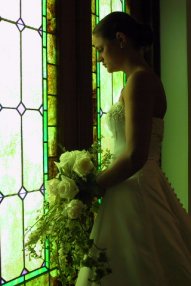
Beautiful Wedding Bouquet

The wedding season is here, and brides-to-be across the country are busily planning the details of their nuptials. From the gowns to the food, from the invitations to the music…. and including, of course, the flowers…. careful decisions are being made which will assure a beautiful and memorable event. It is, after all, meant to be a once in a lifetime experience, and every detail must be perfect.

The Right Wedding Bouquet For Photographs

But no matter how lovely a wedding may be, the fact is that once the festivities are over, it will be the pictures of the event which remain as a permanent record of all those beautiful wedding flowers. Thus, it’s very important to choose bouquets and other floral decorations which will be seen to their best advantage in photographs. A professional florist who has experience in designing for the camera can be an invaluable ally in making sure that your wedding flower pictures are just as beautiful as were the flowers themselves.

The Camera ‘Sees’ Things Differently

Remember that a camera lens “sees” things differently than a human eye… For example, a camera does not perceive depth as well as a person can. For that reason, open spaces within a bouquet should be exaggerated in order to keep the flowers from appearing as one big blob in the photographs.

Dealing With Flash

Flash photography can make the problem even worse, as the bright flash of light tends to flatten out the subject being photographed. This is especially true when dealing with monochromatic (all one color) combinations of flowers. By carefully combining a variety of textures within the bouquet, which will create an interplay of light and shadow, a professional floral designer can compensate for the flash effect and help ensure that the wedding flower pictures will be exquisite.

For instance, hydrangea blossoms, with their rounded form and fluffy, soft texture, have become very popular wedding flowers in recent years. Combine them with velvety-petaled roses or waxy, star shaped stephanotis flowers, and you’ll have the beginnings of a picture perfect bouquet. The variety and contrast among the forms and textures of these flowers will help them stand out from each other in photographs.

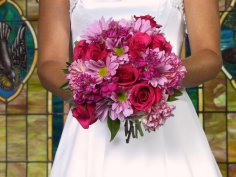
Pink Wedding Bouquet

Dark Flowers

Color is an important consideration for wedding flower pictures as well. Keep in mind that dark, receding hues such as burgundies, purples, blues and deep greens can appear black in photographs, and may turn out looking like black holes in a floral arrangement or bouquet which was gorgeously colored in real life. Appropriate lighting and a skilled photographer can help compensate for this difficulty. Still, it’s a good idea to anticipate the problem beforehand and work with your local florist to create wedding designs which are easier to photograph.

Visit our gallery of wedding flower pictures to see images of all kinds of wedding- appropriate blossoms and blooms. Then consult your professional florist for expert assistance in creating a beautiful and memorable event…. one which will live forever in superb pictures as well as in the hearts and minds of your guests.

Caring for Lucky Bamboo Plants

The so-called Lucky Bamboo has become quite a popular houseplant in recent years. With a resurgent interest among the public in Eastern spirituality, lucky bamboo plants have found a welcome spot in many homes, where they are valued for their interesting, sculptural shapes as well as for their symbolism.

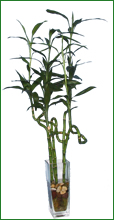
Lucky Bamboo

Lucky Bamboo

Brief History of Lucky Bamboo

With it’s fresh, green hues and it’s vigorous tenacity, bamboo has been considered a symbol of good fortune in Asian cultures for at least 4000 years. It has the ability to thrive in a variety of conditions and to adapt to its surroundings. The ancient Chinese practice of Feng Shui seeks to create a balanced arrangement of the elements of earth, water, wood, metal and fire in order to bring harmony to our living environments. Bamboo is valued as a perfect representative of wood, with its tall, vertical shape and verdant color. This element is said to have an influence on life energy, growth, vitality and physical activity. Because Lucky Bamboo is able to thrive in many areas of the home or workplace where other plants would not, it is frequently cultivated as a means to enhance the positive flow of energy or “chi” in these areas.

Ironically, the plant which is commonly sold as Lucky Bamboo is not really bamboo, but in fact a member of the Dracaena family (Dracaena sanderiana), plants which are well known for their durability under adverse indoor conditions. Because of its ease of care and it apparent resemblance to the true bamboos, this Dracaena is now widely grown.

Lucky Bamboo Care

Caring for lucky bamboo plants is very easy. Typically, they are grown in a few inches of clear water, perhaps supported by small pebbles, stones, or marbles. It is important that the water be kept clean and fresh and not allowed to stagnate. In areas where the local water is heavily treated with chlorine or fluoride, the leaf tips or edges of the lucky bamboo may become yellow or brown. This condition can also be caused by too much salt in the water, known as in “softened” water. Thus, it may be advisable to allow tap water to stand in an open container for 24 hours, allowing the chlorine and flouride to dissipate, before using it with your plants. In the presence of salts, it’s best to used filtered or distilled water.

Lighting

Appropriate light levels are also an important factor in caring for lucky bamboo. The plants grow naturally under the shady canopies of taller rainforest trees. Thus, they prefer an indoor location with bright, indirect light. They will perform well under artificial lighting. Too much direct sun can cause burning of the leaves. Too little light will lead to weak growth, stretching and poor coloration. Normal household temperatures are ideal.

Fertilizer

Since water contains no nutrients, per se, the best care for lucky bamboo plants includes the occasional use of a dilute solution of plant food. Without soil to buffer the fertilizer salts, the roots are susceptible to burning if the solution is too strong. Use any standard house plant food at about one-tenth the recommended dilution rate each time you change the water.

Getting Lucky Bamboo to Twist

Lucky bamboo is frequently seen growing in unusual twisted, curved, or spiraling forms, which seem to enhance its appeal and sense of mystery. The plant does not grow this way naturally. In fact, the curving shapes are produced by laying the plants on their sides, with light directed from the top and shielded from each side, causing them to grow in one direction only toward the light and opposite gravity. The plants are rotated regularly to encourage the spiraling form. Naturally, this is a time-consuming and labor-intensive process which justifies the somewhat higher prices commanded by lucky bamboos.

Your local florist can provide you with your very own lucky bamboo plant, and with just a little simple care, you too can bring a bit of harmony as well as elegant style to your living environment which will last for years. May good fortune smile upon you!

Find a florist near you to order lucky bamboo or see what other House Plants they sell that are easy to grow!


Find a Florist

The Symbolic Meaning of Flowers

Symbolic meanings have been ascribed to flowers since the earliest history of humankind.

  • It has been said that roses first turned red as they blushed with shame at Adam and Eve’s expulsion from the Garden of Eden. 
  • Laurel wreaths placed around the heads of early Greek Olympians symbolized victory and glory.
  • According to Christian legend, carnations sprouted from the ground where Mary’s tears fell as she wept at the foot of the cross upon which Jesus died, and thus are associated with a mother’s undying love.
  • The white lily is strongly linked with Mary throughout art history, symbolizing her virginity, purity, and majesty.
  • And in Ancient Egypt, Cleopatra scattered roses at Marc Anthony’s feet as a symbol of her love.

Love, in fact, is the dominant message among the symbolic meanings of flowers… as well it might be. Flowers, after all, are the sexual reproductive organs of plants, and as such they are emblematic of all sorts of intimate proceedings. Think about that every time you sniff a rose, that most sensual and voluptuous of flowers.

The Language of Flowers

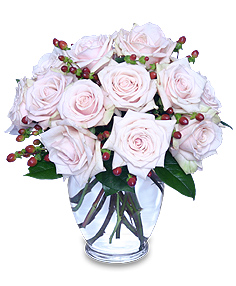
"Rare Beauty" Pale Pink Roses BouquetThere was a time in the past when persons of polite and decorous demeanor never spoke publicly of their romantic feelings. Displays of affection or amorous intent where considered vulgar and inappropriate in a society where all sorts of behavior was proscribed by the social mores of the day. Thus, the so-called “Language of Flowers” evolved as a way to communicate ones deepest feelings in a socially acceptable way. Love was never discussed among polite company during the Elizabethan Age in Europe, restricted by etiquette and conformity. So flowers were used to convey feelings.

The Victorian Era

It was during the Victorian Era that simple messages were assigned to individual flowers. Several small books were published in the late 1800’s which detailed the symbolic meanings of flowers, so that a suitor could send an elaborate, often romantic, secret message to his beloved by combining the appropriate flowers into a telling bouquet, and she could respond in kind. The recipients of such flowers could picture an entire love letter among the blossoms.

And so was born the Language of Flowers. Some of the meanings have changed over the years (for example, a yellow rose once meant “jealousy” but today is most often understood to mean “friendship”), and some of the small books actually contradicted each other… a peony symbolizes either “shame” or “happy marriage”. Nonetheless, we’ve assembled a list of the most commonly accepted symbolic meanings of flowers here. Use them at your own risk.

Rose Meanings

Roses in particular carry a veritable lexicon of quaint expressions of emotion. Everything from modesty to jealousy to gratitude to mourning… and of course, every degree of love… may be expressed by the color, size, shape, maturity, or position of the flower (pictures of roses in arrangements). But a perfect red rose always means “I love you”, a message which will never be confused with any other symbolic meaning of a flower. Contact a professional florist to help you expand your flower vocabulary, and send a well-worded message to someone you love, today.