Home Shop Flowers Bloomin' Blog Find Florists About FSN Contact FSN Florists Only!
Find Your Local Florist:
Home Shop Flowers Bloomin' Blog Find Florists About FSN Contact FSN Florists Only!

Angel Trumpet Or Devil Trumpet?

Angel's Trumpet Ballerina Purple Datura metelAsk The Expert: What is the differences between an angel trumpet and a devil trumpet? – Elaine

Flower Shop Network Plant Expert Reply:

It depends. Most of the time, devil’s trumpet is associated with the genus Datura. These herbaceous leafy annuals/short-lived perennials have lobed toothed alternate leaves with erect flowers and spiny fruit..

Angel’s trumpet are associated with the genus Brugmansia and have pendulous flowers, smooth fruit and are small woody tree/bushes. The large leaves of this plant have fine hairs along the coarsely toothed leaf margin.

Both plants belong to the Solanaceae family and contain toxins.

Hope this information was helpful. Please let me know if I can assist you with anything else!
What Are These Plants In My Mother’s Dish Garden?

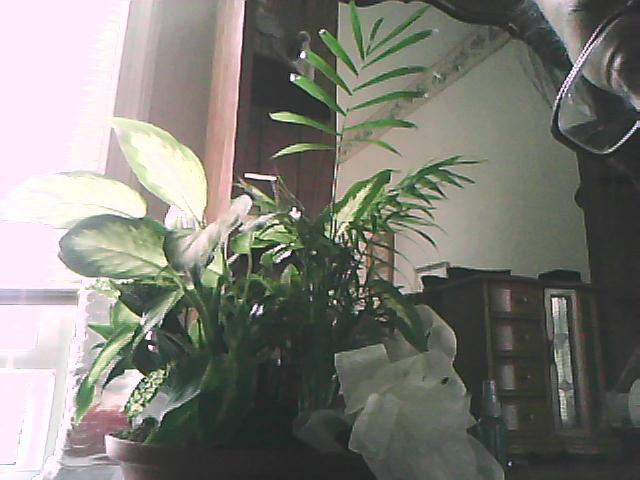
Ask The Expert: What kind of plant is this? I would like to know what kind of plant this is and how I should take care of it please. My mother got it as a gift when her mother died. So i would like to keep it alive as long as possible..

Flower Shop Network Plant Expert Reply: Crystal,
It looks like a dish garden with multiple plants. The tallest plants seems to be a type of parlor palm. However, to identify the other plants I need a close up picture of each one. If you intend to keep all the plants together in the dish garden, I would place it in a medium light location and keep it moderately moist but not soggy.

If you send me pictures of the other plants and want to separate them into multiple containers, I will tell you how to take care of each one.

Ask The Expert: Thank you for your prompt reply and help. These are the best photos I think I’m going to get… Using a crappy laptop webcam, LOL. But I took several, so I hope that helps. And again, thank you so much for your knowledge! :-D Also, the last picture I’ve attached shows what I hope you can see as something eating the plant??? What could that be, at what should I do? Oh, my mom DID mention something about wanting to split the plants up so they can grow more. Thank you, oh Flower Swami. LOL. :-D [Read more…]

What Chemical Property does this tree have?

Ask The Expert: The tree grows about 6-7 mtrs; very straight and skin is very smooth. When the leaves are chewed and digested, or boiled and drank as tea, it causes continuous diarrhea, depending on the amount taken. No other trees or plants, especially crawling plants, grow closer than 1 meter around. If any crawling plant goes any closer, it’ll eventually dry up and die. – John

Flower Shop Network Plant Expert Reply:

John, Without seeing a picture of the tree, I not sure which tree you are talking about. There is an organic compound that occurs naturally in the leaves, bark and roots of some plants. This organic compound is called Juglone. Plants that produce Juglone create a toxic environment for other plants. The Black Walnut is an example of a trees that produces Juglone. I’m not sure if Juglone causes vomiting if consumed by humans, but I do know that it is toxic to horses.

If you could send me a picture of the tree and its bark, I might be able to determine what the tree is and what chemical it produces.

What Is This Tropical Mystery Plant?

Ask The Plant Expert: I have three pictures of a plant I bought at our local grocery store. I just says a tropical plant. Can you tell me what it is and how to care for it. Thanks, Carol.

Flower Shop Network Plant Expert Reply: It appears what you have here is in the Commelinaceae family. It is some type of Callisia, possibly Callisia elegans Striata, (also known as Setcresea striata). But Callisia is a common name for these houseplants. They are native to Central and South America. This plant prefers light to partial shade, warm temperatures (at least 59°F) and humidity. Water generously and spray it often with a spritzer. Feed a balanced fertilizer and trim any long shoots.

Please Help Me Identify A Plant From My Childhood

Ask The Expert: When I was a child my grandma had a flowerbed that had these flowers that had football shaped seed pods.  When the seed pods were touched they would pop open flinging the little black seeds out. As best as I can remember, the plants were about two feet tall, light green in color and I think that the flowers were white.  These flowers were growing in a shady area along with an old-fashioned bleeding heart.  I’m now in my 40’s and I haven’t seen them since.  I was wondering if you could help me.

Flower Shop Network‘s Plant Expert Reply:

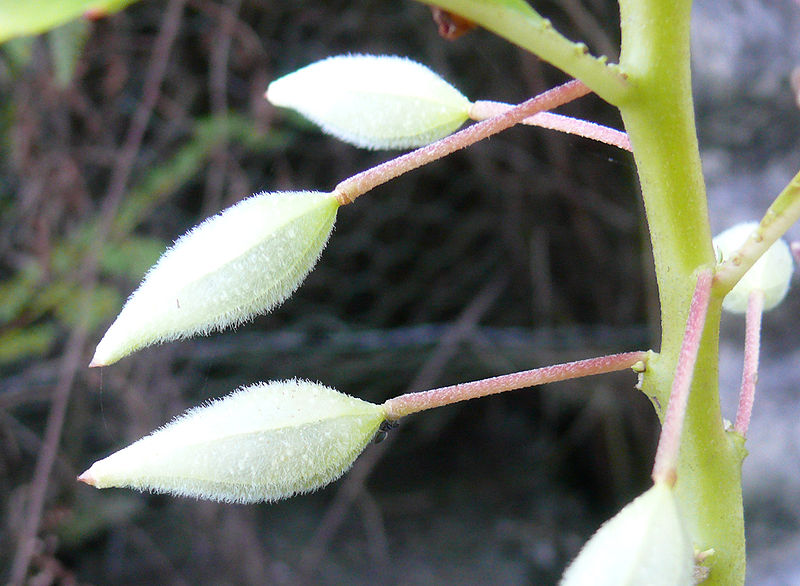
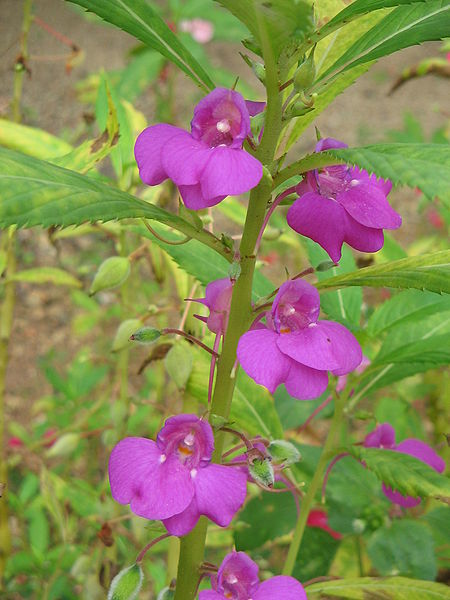
I believe the plant you are asking about is a touch-me-not or Impatiens balsamina. Here is an example of the seed pods and flower:

Impatiens Balsamina Impatiens Balsamina Flower

This post is brought to you by local Springfield MA florists.
Not in Massachusetts? No worries, FlowerShopNetwork.com connects you to a real, local florist.

What are these 2 plants, exactly?

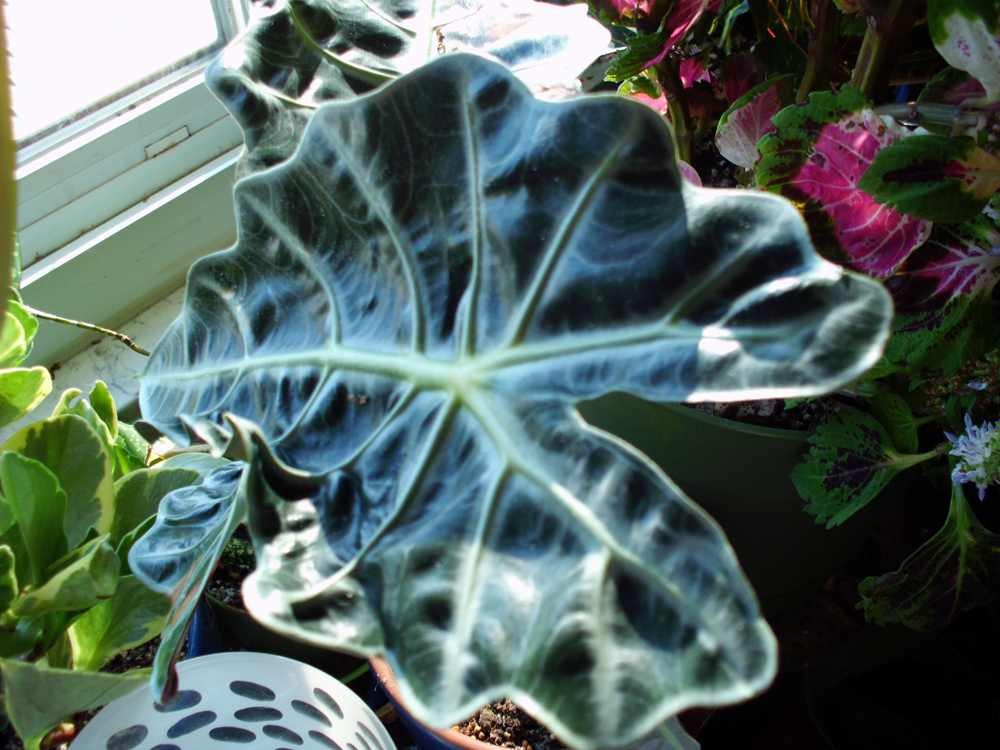
Ask The Plant Expert: First plant to identify is the dark green “elephant eared” typed plant. I have had it inside the house for a while now. It reminds me of a philodendron, but has “wavy” edges ans no holes. The second plant is the Peace Lily. I’m not used to seeing the peace lily having reddish stripes in the flowers. Therefore, Is it really a “peace” lily? – Mikel

Elephant Ear Anthurium

Flower Shop Network‘s Plant Expert Reply: There are some Philodendrons that do look like elephant ears , but I think the first plant is a type of Colocasia or Alocasia commonly known as Taro or Elephant Ear. If I had to base it strictly on the leaf, I would say Alocasia sanderiana.  To really idenitify it I would need a better look at the plant structure – stems, etc.

Bloom structure is like a peace lily, but the leaf structure is completely different than a peace lily. Based on the leaf and bloom together, I would say the second is an Anthurium, most likely an Anthurium andraeanum (Flamingo lily).

Please let me know if you have any other questions.

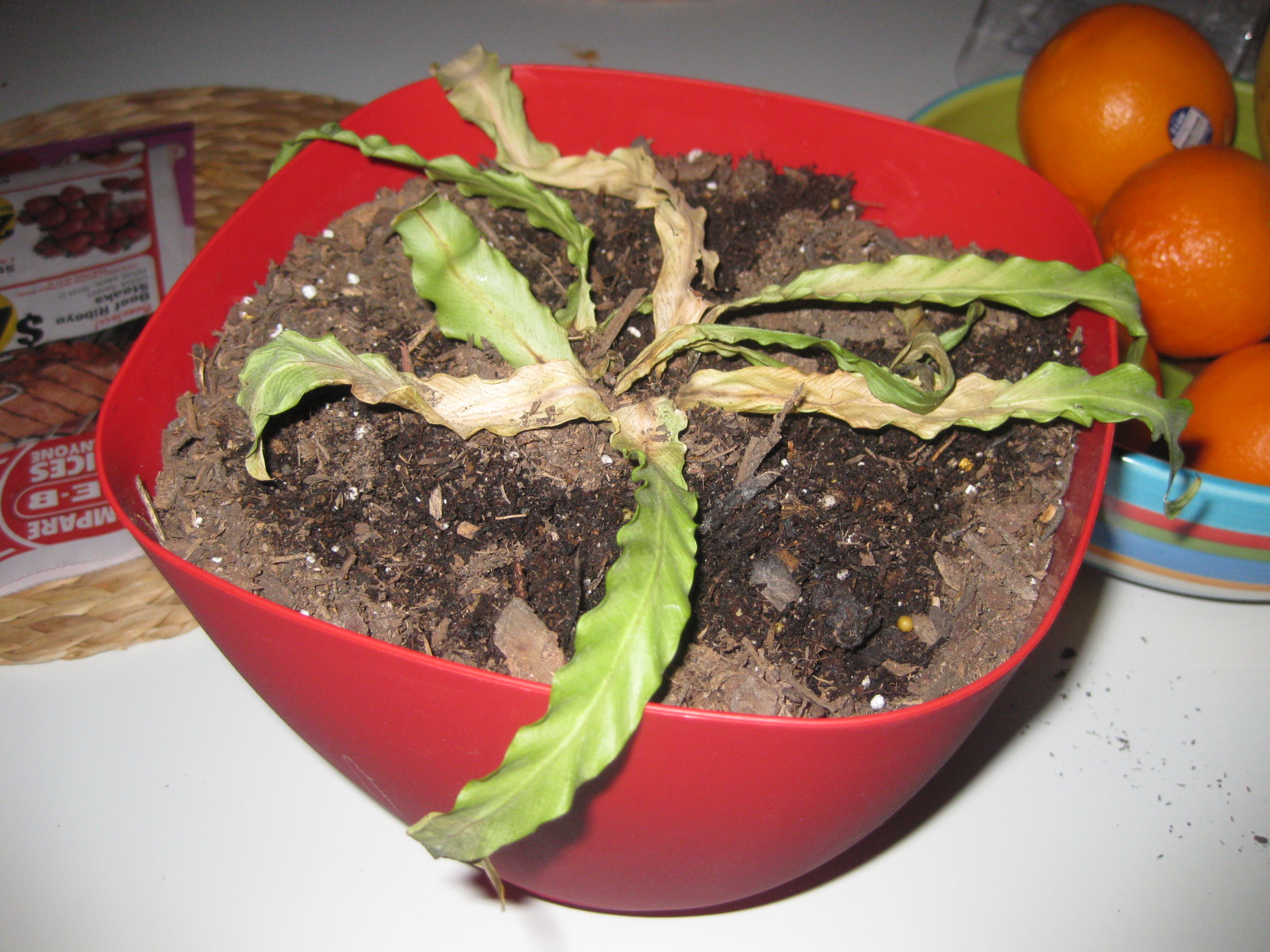
What Happen To My Bird Nest Fern?!?!

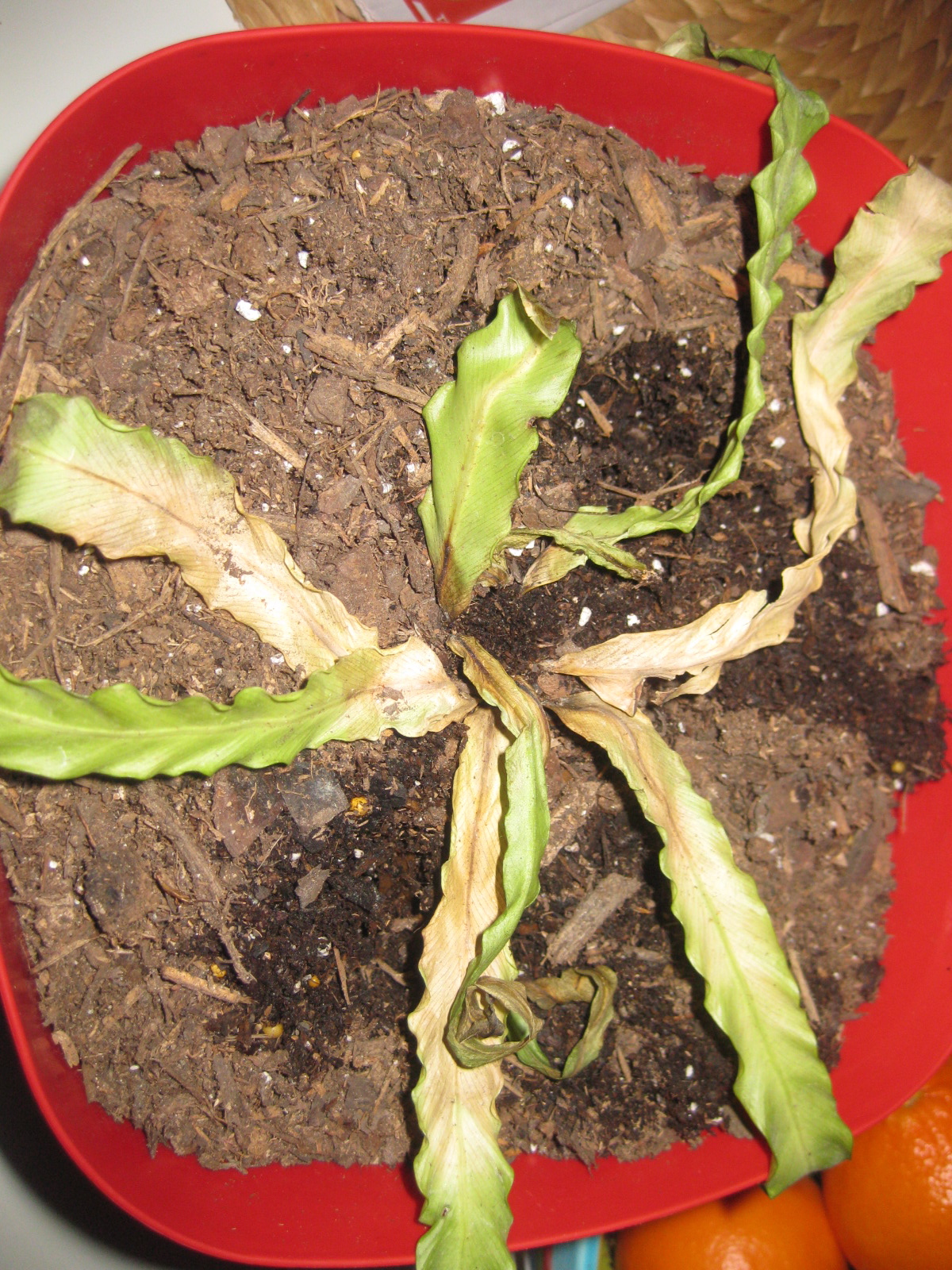
This is the second bird nest fern that has been purchased and the same with the other two, the leaves yellow and start to die… could this have something to do with that air inside my house and the heating? I sent a picture. What’s wrong? Can you help me, I love these plants but not how to look after.
Thanks -Elisa

Birds Nest Fern Birds Nest Fern

Flower Shop Network Plant Expert Reply: After looking at the photos, it appears that 3 things are not suitable for this plant. The soil is a poor quality mix for fern, it is extremely dry, and the pot doesn’t appear to have drainage.

If trying another fern.  Use a good quality potting mix such as Baccto, or Ferti-Lome complete mix, these are peat based soils which are much better suited for ferns.  Use a pot that has drain holes in the bottom with a saucer underneath. Water once to saturate then let dry for 5-7 days, then water again.  The soil shouldn’t get to the point it’s dry to touch on top.

Try to keep the plant out of the direct path of blowing heat. In addition to watering, mist daily if the room is excessively warm and dry (70° or hotter).  Place in a bathroom while showering the steam from the shower will help.

What Is This Full Sun Plant With Fragrance?

Ask the Expert: Could you please help identify plant

I have this plant that seems to do well in my window with full sun, but I am unsure what it is?

The plant is very delicate and has an almost herb like fragrance. Elaine

Sedum

Flower Shop Network Plant Expert: It is one of the many 1000’s of sedums. If I had to pinpoint which sedum, I would say it looks like sedum spathulifolium ‘Cape Blanco’. This type of sedum has several wonderful characteristics:

  • Adaptable as a Houseplant.
  • Attracts Butterflies.
  • Attracts Hummingbirds.
  • Deadheading Not Necessary.
  • Drought Tolerant
  • Fall Interest
  • Heat Tolerant
  • Landscape Plant
  • Low Maintenance

The gray coloring really makes this an interesting plant for rock gardens.

This plant identification question was brought to you by the local Newark Florists. Not in Newark NJ? Use Flower Shop Network to find a verified local florist in your area.

What Is This Plant With Unusual Pink Flower And Silver Leaves?

Ask the Expert: Can you tell me what this plant is received this plant as a gift what is it and how do i care for it. J

Flower Shop Network
Plant Expert Reply: Although the plant has a Sansevieria look, it is actually a type of  Bromeliad. This particular plant is a Aechmea fasciata. With a bloom that lasts 10-12 weeks, it grows to an average 24-27”. It thrives in medium to high light.

For more information about Bromeliads, read our blog post Tropical Bromeliad Basic Houseplant Care or check out the specific care information for the Aechmea fasciata.

Bromeliads are members of the Bromeliaceae (bro-meh-lee-AH-say-eye) family. Pineapple is the most well known Bromeliad. This versatile family contains a wide range of plants; some that look like a pineapple and some that look very un-like a pineapple. They do best indoors in cooler climates, but can be used outdoors in warmer climates (where the temperatures never freeze). They are general easy to grown with long lasting blooms.

This plant identification questions was brought to your by Pensacola Florists. Not in Pensacola FL? Find a local florist near you with FlowerShopNetwork.com

Please Idenitify This Plant And Is It Poisonous To Cats

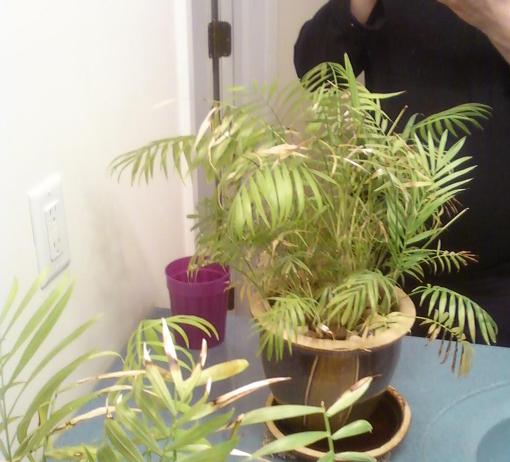
Ask The Plant Expert: Hi Jamie, I came across your info via google and was wondering if you could possibly help me identify two plants that we have at our house.

I am ultimately trying to find out if they are hazardous to cats but have not had any success at identifying the names. I would sincerely appreciate any help and have attached pictures.

Sincerely,
Karen

Flower Shop Network Plant Expert Reply: What you have are Chamaedorea elegans also known as parlor plams, Neanthe bella palms, or table top palms. They are not poisonous to cats or dogs.